Concept Mapping Instruction as an Activator of Students' Performance in the Teaching and Learning of Excretion- Juniper Publishers
JUNIPER PUBLISHERS- OPEN ACCESS JOURNAL OF REVIEWS & RESEARCH
Concept
Mapping Instruction as an Activator of Students' Performance in the Teaching
and Learning of Excretion
Authored
by Ameyaw Y
Abstract
Concept mapping instructional approach as an
activator of students' performance in the teaching and learning of
excretion was investigated.
The quasi experimental design was employed. Purposive sampling technique
was used to select three intact biology classes of SHS 2 students with a
total sample size of 108. The two main instruments used for data
collection were General Knowledge in Biology Performance Test (GKBPT)
and Students' Performance Test in Excretion (SPTE) with K-R 20
reliability coefficient of 0.812 and 0.866 respectively. Point Bi-serial
Correlation, Wilcoxon Signed Rank test, effect size, chi-square and
Kruskal-Wallis H test were employed to analyse the quantitative data
collected using the students' achievement scores. The study showed that
the effect size of the students' performance in the concept mapping of
the post-test scores was better than that of the pre-test scores. The
instructional approach did not only improve students' achievement in the
biology course but also helped the students to retain the concept
learned for longer period. Based on the result, recommendations have
been made.
Keywords: Concept Mapping; Effect Size; Excretion; Senior High School
Introduction
Okwo & Tartiyus [1]
posited that Biology is a natural science subject comprising curriculum
content from microscopic organisms to the biosphere in general,
encompassing the earth's surface and all living things. Considering its
fundamental characteristics and importance, Biology is today a standard
subject of instruction at all levels of our educational systems, from
pre-primary to tertiary. Essentially it could be considered the only
core science subject at Senior Secondary School Certificate Examination
(SSSCE), whose study is very relevant to man's successful living [2].
Biology occupies a unique position in the school curriculum, and is
central to many science related disciplines such as Medicine, pharmacy,
agriculture, nursing and biochemistry. The knowledge of Biology,
chemistry and physics which have been crystallised into concepts,
empirical laws and theories form the basis of our material comfort. The
knowledge of Biology contributes to scientific literacy so that people
can understand the world around them and enable them to make informed
choices about their health care, their environment and the society in
which they live [3]. As we entered the 21st
century and expected better health for all; abundant food for all;
better knowledge of man, animals and plants; and less polluted
environments with Sulphur (IV) Oxide and radio-active substances, there
is the need to effectively teach and learn Biology to meet these
challenges.
The sensitive position Biology plays in medical
sciences, environmental sciences and other related disciplines has
informed several efforts geared toward studying biology at a secondary
level of education in many parts of the world including Ghana. Hence, it
is one of the science subjects one must pass so as to qualify to pursue
some science courses at the tertiary level of education.
For these reasons, the biology Teaching Syllabus [4],
for Senior High School (SHS) in Ghana, aims at assisting the learner to
appreciate the diversity of living things; understand the structure and
functions of living things; develop scientific approach to solving
personal and societal (environmental, economic and health) problems,
develop practical skills required to work with scientific equipment,
biological materials and living things; collect, analyse and interpret
biological data; and also present data graphically It also focuses on
making biology students aware of the existence of interrelationships
between biology and other scientific disciplines; appreciate and
understand the interrelationships between organisms and themselves and
with the environment, and sustain their interest in studying biology.
Despite the importance of the knowledge of biology
for socio-economic development of a country, it has been reported that
performance in biology at SHS level has been poor in most parts of the
Sub-Saharan Africa and Ghana is no exception [46].
Ahmed reported that biology is popular among Nigerian students, yet
their performance in it at Secondary School level is low. The situation
is not different in Kenya. For instance, the Ministry of Education of
Kenya in 2005 indicated that there is a decline in the performance of
students in biology.
In Ghana, Dzidzinyo, Bonney & Davis [6]
reported in their study titled "an investigation into weaknesses
exhibited by Senior High School biology Students' in graph work in the
Cape Coast Metropolis of Ghana” that with the passing of years, many
students who sit the SSSCE in the sciences, specifically, biology, do
not perform as expected. They further lamented that this has been a
constant source of worry to parents, teachers, educationists and those
who have the advancement of science education in Ghana at heart. Again,
it was indicated in the work of Dzidzinyo et al. [6]
that the performance in biology has also not seen any significant
difference over the years as evidenced by the general comments in the [7-12] in both biology 1 and 2 papers.
The researchers believe that students' inability to
deeply conceptualise the individual topics treated in biology could
account for their woeful performance in the biology papers in general.
For example, studies consistently showed that students have problems in
understanding key topics of biology such as internal organs, organ
systems and processes of their own bodies [13-15]. Toyoma [14]
evaluated young children's awareness of biological transformations
associated with eating and breathing and showed that young children
seldom refer to biological transformation. Results from an international
study [13]
indicated that about 15 year-old students' (from 11 different
countries) understanding of different organ systems showed that the
generally best known organs belong to the digestive system, the gaseous
exchange system and the skeletal system. It was evidenced in the study
conducted by Reiss et al. [13] that students had better knowledge of their internal organs but most of them had little understanding of their organ system. [15] reiterated that students had greater difficulties in understanding the excretory systems than the digestive.
The students' difficulties in understanding excretory
systems are mainly caused by ineffective learning or poor teaching in
the classroom [16].
Lawson furthered that when appropriate teaching and learning approaches
are not employed in the classroom, students turn to develop certain
misconceptions about the topic learned, particularly those that are
concerned with more complex or abstract phenomena such as cell division,
ultra filtration in nephrons and the mechanism of circulation, children
are less likely to come into immediate and direct contact with them in
daily life, and so have little chance to develop their own 'naive'
explanations (Cho, Kahle, & Nordland, 1985) [17-19].
Muraya [20]
emphasised that teacher-centred teaching approach, inadequate mastery
of subject matter by the teachers and inadequate teaching and learning
resources are among other contributing factors that impede students'
conception and performance in certain topics in biology. They emphasised
that the teaching approach employed by a teacher is one of the most
important explanations of poor performance in science subjects. One
teaching approach which has been identified to be dominant in Secondary
School level is lecture method [21].
It is teacher- centred teaching approach where a teacher presents
information to students in a lecture and students complete assignments
out of class and later take an examination to demonstrate their degree
of understanding and retention of the subject matter. The lecture method
which is predominant in our classrooms does not stimulate students'
thinking [22,23].
Brown, Oke & Brown (1982) opined that teaching
and learning is an attempt to help someone acquire or change some
knowledge, skill or attitude. Ayot & Patel (1992) further argued
that teaching and learning is a process where one person, the teacher
intentionally passes information to another person, the learner. Hence,
the goal of teaching is to bring about desirable learning in students.
In this process, the learner is expected to receive information,
understand it and use it later when the need arises. For effective
teaching and learning to occur, the teacher must use an effective
approach of conveying the information to the learner (Brown et al.,
1982). He further noted that the way a teacher teaches is important in
that with the right methods and techniques, students can grasp concepts
and ideas while poor methods and techniques frustrate students and
minimize their chances of success.
The instructional strategies that have been identified to aid students' conception and performance are concept mapping [24] and co-operative learning [25,26], which are practically non-existent in the situation where the researchers conducted the study.
Statement of the problem
Science contributes immensely towards the
socio-economic development of a country. For this reason, the Government
of Ghana is committed to improving the quality of science education at
all levels but in particular at the basic and the SHS levels [27]. However, performance in biology at Senior High School level in Ghana remains poor over the years [28].
Biology Chief Examiners' reports noted that over the past decades
students obtained worse grades in biology than in other pure science
subjects. For example, Programme Reform and Alignment for increasing
Competencies of Teachers and for Improving Comprehension and Application
in Learning Science and Mathematics (PRACTICAL) project plan, showed
that in 1999, 2000, 2001, 2002, 2003, 2004 and 2005 students who had
grades A to D were 31.7%, 19.2%, 27.6%, 39.0%, 38.7% 39.4% and 40.9%
respectively . This indicates that over a period of seven consecutive
years less than 50% of the candidates had passing grades in biology that
could qualify them for further studies [6].
The situation is not different from Aburaman Senior
High School in the Abura-Asebu-Kwamankese District in the Central Region
of Ghana. Table 1 shows how woefully the school performed in biology from 2012 to 2015 May/June WASSCE
Field source (2016)
Clearly, from Table 1 it can be seen that the students' performance in biology is heart breaking. It is quite sad to learn from the Table 1
that only 1.7% (2 out of 113 students), 21% (33 out of 151 students),
54.4% (43 out of 79 students) and 25.5% (27 out of 106 students) who
respectively sat 2012, 2013, 2014 and 2015 WASSCE biology obtained
grades A1 to C6. This means that in 2012, 2013 and 2015 far more than
half of the students could not qualify for tertiary programme.

The students’ abysmal performance in biology could be that they do not fully conceptualise most of the topics treated in the subject. For instance most literature revealed that students harbour many misconceptions relating to basic biological concepts after teaching [19,29-31]. One area that continually causes learning problems is concerned with the concept of excretion. A particular case is many students are unable to distinguish between excretion and egestion even after deliberate instruction, and their ideas on excretory wastes are confusing [32].
Abimbola 1O [33]
indicated that physiology content areas are mostly abstract and
microscopic involving many processes and that both teachers and students
find these areas difficult to deal with. For example, ultrafiltration
and selective reabsorption as functions performed by the kidney was not
understood by these students. Again, vasoconstriction and vasodilation
with respect to temperature regulation by the skin were also not clear
to them.
The students' learning difficulties in most concepts
have been attributed to teaching method, which was teacher-active and
traditional method [20]. The teacher-centred approaches are predominantly practised at Secondary School level in SubSahara Africa [21,34].
The classrooms in the district where this study was carried out are not
exception of the use of the teacher- centred teaching approach. This
teaching approach is heavily criticised because it is usually
characterised by heavy emphasis on assessment, lot of notes being copied
and students hardly ask questions in the classroom. Students are most
often not given much opportunity to construct and negotiate their own
meaning of biological concepts; the teacher is the producer of the
knowledge. Not only does it promote students' passiveness in the
classroom, it declines students' interest in the subject [35]. Further, Adunola (2011) cited in [36]
confirmed that this instructional approach is one of the major causes
of woeful academic performance in biology. All these findings suggest
that one underlying premise contributing to the learners' difficulty in
developing their conceptual understanding well in excretion is the way
the topic is structured and presented. Thus, the emphasis on teaching
excretion in a way that is understandable to students should be a
concern to science educators.
Though, it has been identified that concept mapping
and co-operative learning are instructional approaches that perk up
students' performance in biology [37,38]
Nnorom, 2015, these are virtually non-existent in most of the
classrooms in Ghana. Cooperative instructional approach actively
involves learners in the teaching and learning process thereby promoting
more learning and higher academic achievement than traditional teacher-
centred approaches [37].
It also promotes a more positive attitude towards the subject which is
essential for enhancing learning. Studies have also confirmed that use
of co-operative instructional approach improves academic achievement and
interest towards the subject. Again, some studies on the effects of
concept mapping when used as an instructional tool for teaching and
learning, indicated its relevance in improving the cognitive and
affective aspects of learning. For example, [38]
in determining the effects of concept mapping as a study skill on
student's achievement in biology indicated a significant and consistent
improvement in biology achievement as compared with lecture method of
instruction.
In an attempt to identify better instructional
approach in teaching a particular biological concept, most literature
reviewed for this study often compared a very sophisticated
instructional approach (example: concept mapping, co-operative,
experiential and technological instructional approaches) to an
ill-structured teaching strategy (e.g. lecture method which is less
studentcentred). What is missing in most literature is the comparison of
the effectiveness of two robust teaching approaches such as concept
mapping and co-operative learning, each of which has been confirmed to
be superior to conventional or traditional methods of teaching. Also,
most of the studies on the effects of concept mapping and co-operative
learning on the students' performance were conducted outside Ghana. It
is in the light of these that, the researchers' aims at comparing the
effectiveness of concept mapping and co-operative learning on students’
performance in excretion in the Ghanaian context. Therefore, it is of
interest to explore the extent to which students' misconception in
excretion could be rectified by using the concept mapping as an
instructional strategy.
Research questions
The following research questions were used for the study:
1. What misconceptions do SHS 2 students have about the concept of excretion?
2. To what extent does the use of concept mapping instructional approach improves students' performance in excretion?
Methodology
This study was meant to determine the effect of
concept mapping approach on performance of Senior High School students
in excretion. Therefore, quasi-experimental research design involving
non-equivalent pre-test and post-test control group was considered the
most appropriate.
Validity
In this study, face and content validity were used to
ascertain the validity of the instrument. Face and content validity are
qualitative measures of validity and are often employed in educational
research because they are the easiest to ascertain.
Further, item analysis was performed to determine
whether an item functions as intended. The item analysis provided
information whether the item was of the appropriate level of difficulty
or whether it distinguished between high achievers and low achievers or
whether the options were working.
Discrimination Index
The discrimination index was calculated for each test
item of the GKBPT and SPTE. The discrimination index is the difference
between the percentage of students in upper and lower groups who got the
items correct. Generally, students who did well on the test should
select the correct answer to any given item on the test. Thus,
discrimination index distinguishes for each item between the performance
of students who did well on the test and students who did poorly
To calculate the discrimination index, first the marked papers were arranged from highest score to the lowest score. The papers (N = 60) were grouped into three: upper, middle and lower groups using top 27% (16 students) and the bottom 27% (16 students).
The formula used to calculate the discrimination index is:

Where D = discrimination index, RU = number among the
upper 27% of respondents who scored the item correct, RL = number among
the lower 27% of respondents who scored the item correct and N= total
number of respondents.
For examination with a normal distribution,
discrimination index of 0.3 and above is good; 0.6 and above is very
good. Values close to zero mean that most students performed the same on
an item. The index should never be negative [39].
The indiscrimination indices for all the items in the GKBPT were found
to be within the acceptable range. However, items Q19, Q22, Q26, and Q27
of the SPTE had low discrimination indices and were carefully examined
for possible presence of ambiguity and clues.
Difficulty Index
The difficulty index for each item of the GKBPT and
SPTE (Appendix F) was calculated. The difficulty index is the percentage
of the total number of students who got the item correct. Difficulty
index can also be interpreted as how easy or how difficult an item is.
This was calculated using the following formula:

Where: D1: Difficulty Index; R: Number of Correct Responses; T: Total Number of Students
Santos S [40]
suggested a benchmark for interpreting the difficulty index. He
suggested that items with difficulty index of 0.00 to 0.25 means the
item is difficult and needs to be revised or discarded, 0.26 to 0.75
means the item is appropriate and needs to be retained and 0.76 to 1.0
means the item is too easy and the item needs to be revised or
discarded.
From the calculation, items 14, 17, and 30 of SPTE
were above easy levels of difficulty. These items were revised and
maintained. In all, the results from the difficulty index helped to
carefully examine the options for each item and the necessary
corrections were then made.
Reliability
The Kuder-Richardson 20 formula (K-R 20) was used to
determine the reliability coefficient of achievement test items. The
reason for choosing K-R 20 test statistics is it measures the internal
consistency of items with dichotomous choices. Table 2 provides the reliability coefficients of the achievement tests.
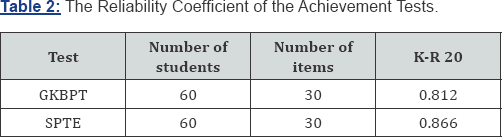
From Table 2, the K-R 20 reliability coefficient of the achievement test items for GKBPT and SPTE were found to be 0.812 and 0.866 respectively. The reliability coefficient of 0.866 means that 86.6% of variability in scores is due to true score differences among examinees, while the remaining 14.4% (1.00 - 0.866) is due to measurement error. Therefore, the reliability coefficients of 0.812 and 0.866 obtained in this study confirmed that the achievement tests used in the main study were within the acceptable benchmark of instruments being reliable [41-44].
Instruments
The main instruments used in the study were the two-
teacher made achievement tests: General Knowledge in Biology Performance
Test (GKBPT) and Students' Performance Test in Excretion (SPTE). Both
tests were developed by the author.
Data analysis
Cohen d statistic was used to determine the effect size. The bench mark for interpreting Cohen d values are 0.20= small effect, 0.50 = moderate effect, 0.80 = large effect and 1.30 = very large [45]. Therefore, the Cohen d value determined in this study was compared with these standard values and conclusion drawn thereafter
Results
All statistical works that were used for making
analysis, testing hypotheses, interpreting results and as
evidenced-based answers to the research questions have all being
presented here.
What Misconceptions do SHS 2 Students have about the Concept of Excretion?
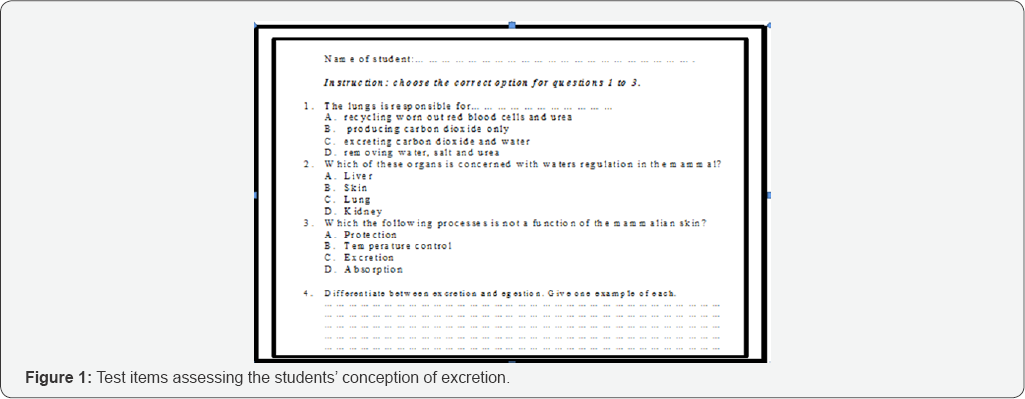
To verify students' misconception of excretion, they were asked to provide responses to questions on excretion (Figure 1)
prior to the execution of the interventions and their responses were
analysed as follows. The items 1 to 3 are low level questions requiring
the students to recall the functions of the various excretory
organs-lungs, kidney and skin. The point biserial correlation was used
to calculate the item-test correlation, which serves as the
discrimination index. As a rule of thumb, a discrimination index greater
than or equal to 0.2 is usually considered as acceptable (Table 3).

The correct option is marked with asterisk *.
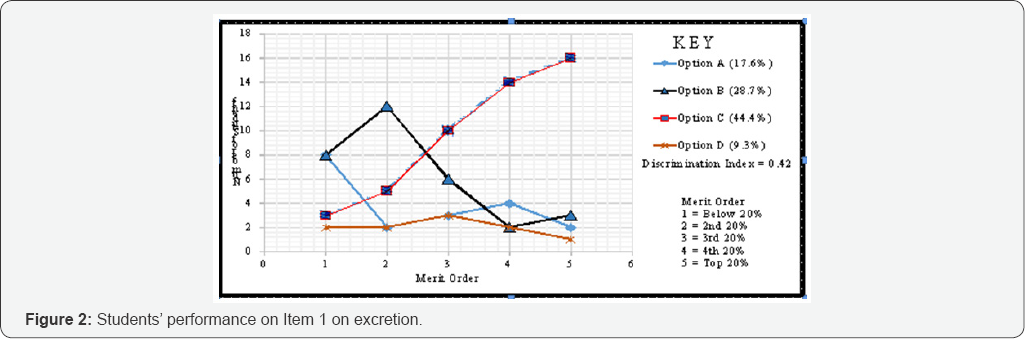
From Table 3, the frequency of choices made by the students on the distracters for the various test items (items 1 to 3) divulged the prevalence of certain misunderstandings on excretion. The pattern of responses across ability groups provided some insight into the nature of the misconceptions. According to their overall performance in this test, the students (N = 108) were divided into five ability groups of equal numbers; the first 20% ability group included students with the lowest scores while the top 20% ability group was made up of those with the highest scores. The number of candidates in the five ability groups choosing each option is presented in the form of a line graph. The patterns of performance thus obtained illustrated how well an option, whether it is the correct answer or a distracter, discriminated the high-ranking and low-ranking students. For instance, the students' overall performance on item 1 is illustrated in Figure 2
The concept of excretion is elementary to the SHS
biology curriculum and is usually introduced to students at a very early
stage of the course when teaching about the characteristics of living
organisms while the mechanisms of excretion are elaborated on, at a
later stage. The poor performance on this item is therefore rather
startling as it was correctly answered by less than half of the
candidates (44.4%); most students did not recall that the lung is
responsible for releasing carbon dioxide and water. One possible reason
for the low success rate is that many students were not able to relate
the removal of carbon dioxide during exhalation to an excretory role the
lungs play. It could also be that the students did not have in their
repertoire that the lung removes carbon dioxide and water (waste
products of cellular respiration). These waste products are expelled in
the form of gas during the process of exhalation.
Option B was a very strong distracter as it attracted
a significant number of students (28.7%). These students wrongly
considered carbon dioxide as the only metabolic waste the lung produces.
The line graph for this option demonstrates that this flawed view was
prevalent among the middle- and low-ability groups. This pattern
suggests that the idea of metabolic waste is a difficult and abstract
concept for the average student and is not well conceptualised even
after formal instruction.
Option D attracted the least number of students
(9.3%). It is the skin but not the lung responsible for the release of
water, salt and urea. It is quite unfathomable that students who had
received formal instruction in excretion could erroneously think that
tlhe lung is responsible for releasing water, salt and urea.
Furthermore, the students' written responses to item 4
(Differentiate between excretion and egestion. Give one example of
each.) Indicated that most of the students provided scientifically
acceptable definitions for excretion and egestion. The distribution of
the students' responses were categorised into correct definition with
example, correct definition but wrong example, wrong definition but
correct example, and wrong definition and wrong example (Figure 3).
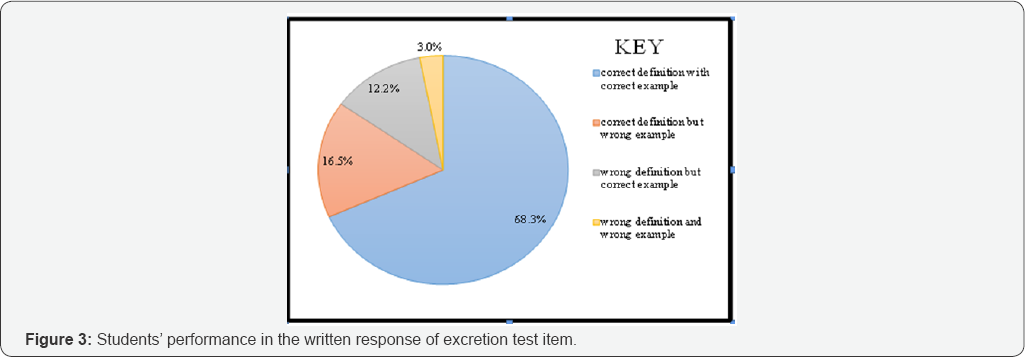
The results in Figure 3 show that the students (68.3%) were able to give one correct example of excretory wastes of the body, which include carbon dioxide, urea, water and salt. Also, most of them were able to state digested (e.g. faeces) or indigestible food as egestion. Though majority of the students were able to demonstrate an adequate level of understanding of the meaning of excretion and egestion, the 37.7% of the students who were unable to write pleasingly response is very significant and alarming.
To recap, the erroneous response these students
provided to the test items on excretion clearly shows that there are
some misconceptions and misunderstanding perpetuated by the students
after they had received formal instruction. Therefore, a robust
instructional approach is really needed to address the students'
misconceptions and performance in excretion.
Discussion
It is evidenced in the literature reviewed for this
study that students normally held some misconceptions in certain
biological concepts after they had received some formal instruction [19,2931].
Therefore, this study was to verify whether this is the case of
Aburaman Senior High School. The research question that guided this
investigation was "What misconceptions do SHS 2 students have about the
concept of excretion?” The data collected through students' responses to
three multiple-choice items and one open-ended question on excretion
confirmed that students held to certain degree some misconceptions in
excretion. For instance, it was evidenced in this study that less than
half of the students (44.4%) did not recall that the lung is responsible
for releasing carbon dioxide and water. Rather a significant number of
students (28.7%) wrongly considered carbon dioxide as the only metabolic
waste the lung produces. Again, it was shown in this study that though
majority of the students (68.3%) were able to demonstrate an appreciable
level of understanding of the meaning of excretion and egestion with
correct examples, the 37.7% of students were unable to write agreeably
response is very significant and disquieting.
The results from this study are consistent with the findings of the studies conducted by [30-32,46-48]. For example, [32]
identified in his study that many students failed to distinguish
between excretion and egestion even after deliberate instruction, and
their ideas on excretory wastes are confusing. [46,47]
reiterated in their studies that most students having completed the
secondary curriculum, failed to develop a proper understanding of the
concept excretion.
More so, it was identified that 9.3% of the students
whom had received instruction on excretion prior to the study could not
conceptualise that the skin is responsible for the release of water,
salt and urea. It is quite unfathomable that students who had received
formal instruction in excretion could erroneously think that the lung is
responsible for releasing water, salt and urea. It is also interesting
to observe from this study that this conceptual quandary was shown by
students of all ranks to a similar extent, which means that even some of
the high ability students had difficulties in distinguishing the
excretory organ responsible for the release of water, salt and urea.
To What Extent does the Use ofConcept Mapping Instructional Approach Improve Students' Performance in Excretion?
To verify the extent to which the use of concept
mapping as an instructional approach improves students' performance in
excretion, the mean, standard deviation, effect size and Wilcoxon Signed
Rank Test statistics were used to analyse the students' pre-test and
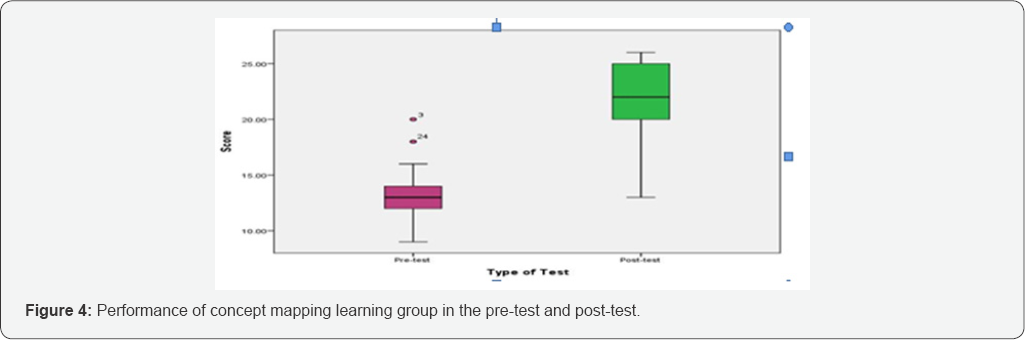
post test scores (Table 4). Also, box plot (Figure 4)
was used to give pictorial illustration of the performance of the
students in the achievement of both pre-test and post-test scores From Table 4,
the students' mean scores of the achievement test before and after the
use of the concept mapping instructional approach are 13.17 (SD = 2.16)
and 22.09 (SD = 3.50) respectively. There has been an increase in the
achievement test scores from pre-test (prior to the intervention) to
post-test (after the intervention). Also, it can be seen from the result
in Table 4
that there was a mean difference of 8.92 between the pre-test scores
and post-test mean scores. The Wilcoxon Signed Rank test was conducted
at 5% significant level to find out if the mean difference of 8.92 was
significant. This revealed a statistically significant difference in the
learners' achievement in excretion (Z = -5.16, p-value = 0.001 <
0.05). The effect size statistic (Cohen d = 3.07) indicated large effect
size which implied that concept mapping instructional approach had a
positive effect on the learners' achievement. That is, there was a
substantial difference in the students' achievement test scores after
the teaching of excretion through concept mapping. Pictorially, the
difference between the students' pre-test and post-test scores in terms
of distance travelled is shown in Figure 4.

Significance level, α: 0.05; M: Mean; SD: Standard Deviation
From Figure 4, it can be observed that the learners improved tremendously in their achievement and understanding of the concept excretion through the use of concept mapping. For instance, it can be seen from the box plot that the minimum score the students obtained in the post-test is approximately equal to the mean score they had in the pre-test. This seems to suggest that using the concept mapping as an instructional approach could enhance students' performance greatly.
The Effects of Concept Mapping Instructional Approach on Students' Performance in Excretion
The research question 2 of this study guided the
exploration of the effects of concept mapping instructional approach on
students' performance in excretion. The results of the data collected
through students' achievement test scores in excretion indicated that
the students' mean scores before and after the use of the concept
mapping instructional approach are 13.17 (SD = 2.16) and 22.09 (SD =
3.50) respectively. The mean difference of 8.92 between the pre-test
scores and post-test mean scores was statistically significant (Z =
-5.16, p-value = 0.001 < 0.05). This implies that there was a
substantial difference in the students' achievement test scores after
the teaching of excretion through concept mapping. This result agrees
with the previous studies which indicated that students' understanding
of biological concept is fully enhance when concept mapping is employed
as instructional approach (Henno & Reiska, 2008) [24,38,48-53].
Ajaja OP [38]
for instance concluded in his study that the use of concept mapping as
an instructional approach does not only improve students' achievement in
biology course but it enhances students to retain the concept learned
for longer period. Again, Henno & Reiska (2008) illuminated in their
study that the use of concept mapping enables students to create
interconnected ideas in biology there by expounding their conception in
the topic learnt. Theys added that using concept mapping facilitates
meaningful learning and creates powerful knowledge frameworks that not
only permit the students to utilise the knowledge in new contexts, but
also enhances the retention of the knowledge for long periods of time
Novak 1990 [52,54]. Bransford, Brown and Cocking (1999) and [54] highlighted that concept mapping enhances the brain to process and organize knowledge in hierarchical frameworks. [50]
in a study discovered a significant effect of concept mapping
instructional strategy on students' learning achievements. They asserted
that concept mapping instructional strategy had a spun-out effect that
prompts recall of learned materials [55-72].
Conclusion
It can be concluded from the above findings and
result that concept mapping and co-operative learning have more positive
effects on students' achievement in excretion than the lecture method.
Students' achievement of excretion can be enhanced by the use of
effective instructional strategy.
Recommendations
Based on the findings of this study, the following recommendations are made:
The students in the concept mapping group performed
significantly better than the students in the lecture method group.
Therefore, further empirical studies should be carried out on the use of
concept mapping and co-operative learning on different topics in
biology and at different levels to provide sound basis for their usage
in Senior High Schools in Abura- Asebu-Kwamankese District.
Acknowledgement
The authors' appreciates the contributions made by
the authorities, staff and students of Aburaman Senior High Schools for
supporting this study
For more Open Access Journals in Juniper Publishers please
click on: https://juniperpublishers.com
For more articles in Open Access Journal of Reviews &
Research please click on:
https://juniperpublishers.com/arr/index.php
https://juniperpublishers.com/arr/index.php
To know more about Peer Review Journal
of Reviews & Research click on:


Comments
Post a Comment